The Decluttering Myth: Every Item Needs a Permanent Home
Decluttering does not require a permanent home for every item. Learn when daily-use belongings need fixed storage and when shared space works better.
Does decluttering mean finding a permanent home for every item? No. Decluttering works better when the storage matches how often you use something and how easily you can put it away. A fixed place suits belongings you reach for routinely; occasional items can share a clearly defined space without each having its own dedicated container or shelf.
The pressure to assign every object a separate spot can turn a cupboard into a detailed filing system. That is not always useful. The practical aim is to make belongings easy to find and put away, while leaving room for the ordinary changes a household brings.
Does every item need a permanent home?
No. A permanent home is most useful when an item is used often, needs to be found quickly, or is easy to misplace among other belongings. A phone charger, the scissors used for parcels, or a favourite mug can earn a specific place because people expect to reach for them repeatedly.
Other objects do not need an individual address. A spare serving jug might be used only when friends visit; a small toolkit may come out for occasional household tasks. If these things are contained together in a known cupboard or box, they have a reliable place without consuming separate prime storage.
Think of storage as a service, not a rule. Its job is to make the next use straightforward, not to prove that every object has been carefully categorised.
Which belongings benefit from a fixed place?
Give a fixed spot to items whose absence would interrupt a familiar routine. Common examples include keys near the usual entrance, a pen by the household calendar, or the remote beside the seat where it is used. The exact location matters less than being consistent and convenient for the people who use it.
Fixed storage also helps when objects are small, easily confused, or used by more than one person. A labelled drawer for batteries, for instance, can be more useful than scattering them among several cupboards. The label should describe what belongs there in plain language, rather than impose a complex filing scheme.
Observe what people reach for during an ordinary week. If an object is repeatedly fetched from the same area, a nearby dedicated place may remove a needless detour.
When is a shared place better than a dedicated one?
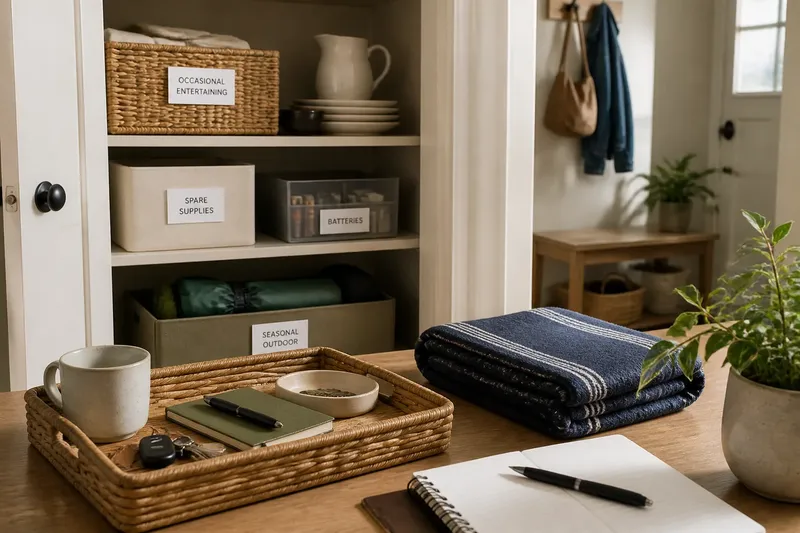
A shared place works well for items that are occasional, similar in purpose, or awkward to assign individually. Seasonal accessories, spare table linens, and small items used for hosting may be kept together in one cupboard, lidded box, or labelled basket. The group has a home, even though each object does not have its own slot.
Shared storage is especially sensible when dedicated places would be mostly empty. Separate bins for every type of rarely used item can take more time to maintain than the belongings deserve. A broad label such as “occasional entertaining” or “spare household supplies” can make a mixed group easy enough to locate.
Keep the category understandable. If a shared box collects unrelated objects simply because they had nowhere else to go, it may become a hiding place rather than useful storage.
How can you choose between fixed storage and a shared place?
Start with use, access, and the effort of putting something away. Ask whether the item appears in a regular routine, whether someone needs to find it quickly, and whether a dedicated spot would be easy to maintain. These questions are more useful than asking whether the object seems important enough to deserve its own container.
- Used frequently: Give it a stable place near where it is normally used.
- Small or easily misplaced: Consider a dedicated drawer section or labelled container.
- Used occasionally with similar items: Keep it in a shared group with a clear label.
- Needed by several people: Choose a place they can all reach and recognise.
- Used unpredictably or between tasks: A temporary landing place may be more realistic than immediate, precise sorting.
- Not used and not needed for a known purpose: Consider whether it still belongs in the household.
Say you use a folding picnic blanket only on warm weekends, and it currently sits in the hallway because no cupboard is reserved for it. You could place it with other occasional outdoor items in a labelled basket on an accessible closet shelf; the expected result is that it can be found with related gear and no longer occupies the hallway. If the basket becomes difficult to close, the group may need less storage or a smaller collection.
What should a temporary place be for?
A temporary place holds an item while its next action is still pending. It is different from permanent storage: a return-to-shop parcel, a borrowed book awaiting its owner, or a tool left out during a task may need a visible landing spot rather than a final cupboard location.
Choose one limited area, such as a tray on a sideboard or a shallow basket near the household calendar. Keep it small enough to notice when it is full. A container that spreads across a table or floor can make pending decisions invisible and harder to finish.
Set a simple cue for clearing it, such as checking the tray before leaving for errands or at the end of a household task. If something remains there repeatedly, decide whether it needs a better permanent location or whether the pending action should be dropped.
How do you stop shared storage becoming a jumble?
Use a container suited to the group, and give it a label that helps someone choose the right place without asking. A soft basket can suit scarves; a shallow box can keep spare light bulbs together; a cupboard shelf may hold occasional serving pieces. The label should identify the contents or purpose, not an abstract category that only one person understands.
Leave some room to return items without rearranging the whole container. Avoid sorting a modest group into layers of smaller boxes unless that structure solves a real problem. A useful shared place is easy to open, scan, and use again.
If several unrelated things keep ending up together, look at why. Perhaps the items are used in the same part of the home, or perhaps the container is simply closest to where people set things down. Adjust the location or the category instead of adding more labels by default.
What if household members disagree about where things belong?
Agree on the places that affect shared routines first: everyday tools, frequently used supplies, and belongings that need to be found by more than one person. For occasional objects, a shared category and broad location may be enough. A system that everyone can use is more valuable than one that is precise but depends on a single person to maintain it.
Test the arrangement through ordinary use. If someone repeatedly leaves an item near the place where it is needed, consider whether the assigned storage is inconvenient or the item belongs in a shared, nearer spot. The pattern is useful information, not a reason to scold anyone.
How can you tell when a storage arrangement needs changing?
Look for a recurring mismatch: a daily-use item buried behind occasional belongings, a shared box that cannot close, or a temporary tray that has become a permanent pile. Those signs suggest the category, location, or amount of storage is no longer serving the routine.
Change one thing at a time. Move frequent-use items nearer their point of use, make an occasional group easier to identify, or clear a landing place that has lost its temporary purpose. Then notice whether people can find and return the belongings with less hesitation.
Decluttering does not require a permanent home for every item; it requires a sensible place for the belongings your household chooses to keep. Reserve fixed storage for routine needs, let occasional items share space, and make temporary places visibly temporary. That approach leaves room for a home to work as people actually use it.