Open Shelves or Closed Cabinets for Daily-use Items?
Choose open shelves or closed cabinets for daily-use items by weighing visibility, reach and visual calm, then match each belonging to its routine.
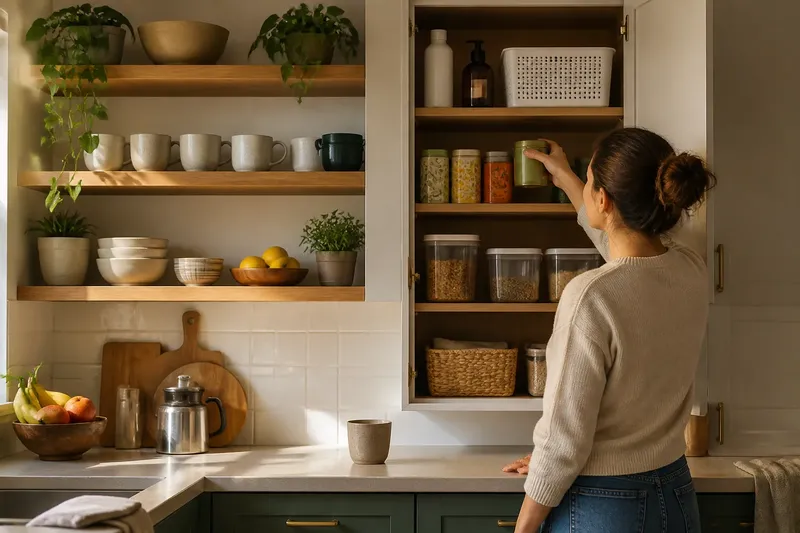
Open shelves or closed cabinets for daily-use items? The answer depends on what you need to see, what you need to reach quickly and how much visual activity feels comfortable in the room. A mug used at breakfast may deserve an easy-to-spot place; spare mugs, rarely used serving dishes or mismatched packaging may be better behind a door.
These storage types solve different problems. Shelves make belongings visible and reachable, while cabinets conceal them and give a room a quieter appearance. Neither is automatically more organised. The useful choice is the one that suits the item’s routine, the person using it and the amount of visual order the space needs.
What does open storage make easier?
An open shelf puts its contents in view. That can help when you rely on seeing an item to remember it, or when you want to take it without opening a door. Everyday glasses beside the sink, a bowl of fruit on a kitchen shelf or a small tray of frequently used toiletries are possible candidates.
Visibility can also reveal when supplies are running low or when an item has been put back in the wrong place. But it comes with a trade-off: every object contributes to the room’s appearance. A shelf holding a small group of similar bowls may look composed; the same shelf crowded with packets, cords and unrelated items may feel busy.
Open storage works best when its contents are used often, look acceptable together and can be returned without fuss. It may suit a household where a closed door would make people forget what is stored or where several people need to find the same things quickly.
Keep visible storage for items you can identify at a glance.
What does a closed cabinet do better?
A cabinet hides its contents behind a door. This reduces visual activity, which can matter in a small kitchen, a shared living space or a room that already has patterned surfaces and several colours. It also lets you group unlike objects together without displaying every package, tool or spare part.
Cabinet doors add a small action before access: open, locate, take, then close. That is no obstacle for items used occasionally, but it may become irritating for something reached repeatedly during a routine. A cabinet can also make contents less visible, so a rarely noticed item may be forgotten or duplicated.
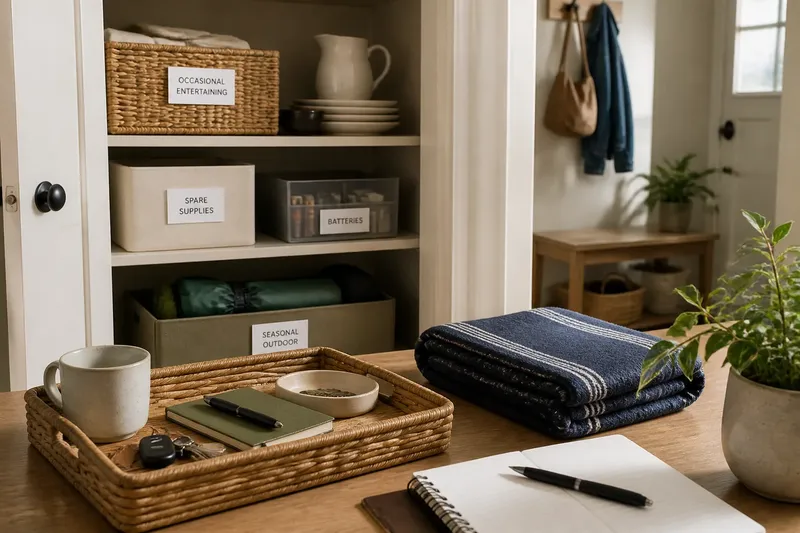
Closed storage is often a better fit for backups, spare supplies, items with visually varied packaging and belongings that do not need to be in immediate reach. It can be useful when you want a room to look calmer without requiring every stored object to match.
Use doors to quiet the view, not to hide an unworkable pile.
How do visibility, access and visual busyness compare?
Consider three separate questions rather than treating storage as a style choice alone:
- Visibility: Does seeing the item help you remember to use it, or would you rather keep it out of sight?
- Access: Do you reach for it often enough that opening a door feels like needless friction?
- Visual busyness: Do its colours, shapes or packaging add clutter to the room when displayed?
These questions can point in different directions. A daily-use item may be easy to reach on a shelf but visually distracting. In that case, a cabinet with an accessible interior could be the better compromise. An attractive object used regularly may be pleasant on display, but appearance alone does not make a shelf practical if it is hard to reach.
Also consider who uses the storage. A clear shelf may work well for an adult who knows where each object belongs, while a labelled or plainly arranged cabinet may be easier for a child or a housemate. Choose an arrangement the people in the home can use, rather than one that depends on a single person maintaining a display.
Which storage option suits which daily-use items?
Open shelves suit belongings that are easy to recognise and put away, especially when quick access matters. Closed cabinets suit items that are less attractive on display, used in batches or best kept together. A combination often handles a mixed routine better than choosing one approach for every object.
- Open shelf: Consider everyday cups, a small set of breakfast bowls or a frequently used seasoning group if the shelf is reachable and the items stay orderly.
- Closed cabinet: Consider spare food containers, backup toiletries, cleaning cloths or packages with different colours and shapes.
- Split arrangement: Keep the current supply visible and put unopened refills in a cabinet, or display the daily dishes while storing less-used serving pieces behind a door.
Say you make tea each morning and keep several types of loose-leaf tea in bright packets. In this invented situation, you could put the daily mug and a small tin of the tea you use most on an open shelf, then store the packets and spare tins in a cabinet. The expected observable result is that the morning items are easy to spot while the colourful assortment no longer fills the visible shelf.
The arrangement should reflect the real sequence of use. If you have to cross the room, reach over other objects or move several things to get to a supposedly convenient shelf, the location is not convenient in practice. Keep frequently used belongings near the place where the routine happens, while avoiding placements that make access awkward or unsuitable for the room.
What questions help you choose open shelves or closed cabinets?
Are open shelves harder to keep tidy?
They can look untidy sooner because each object remains visible, but the amount of upkeep depends on what is stored there and how easily it can be returned. A shelf with a few repeat-use items is simpler to maintain than one that collects unrelated belongings.
Should frequently used items always stay in sight?
No. Visibility helps when it prompts use or speeds up finding something, but it is not essential if you remember the cabinet location and can reach the contents easily. A frequently used item can belong behind a door when a calmer view matters more.
Can open and closed storage share one wall?
Yes. You might display a small group of everyday dishes and keep extra pieces, food packets or less attractive supplies in nearby cupboards. The useful division is by routine and visual effect, not by a rule that all storage must match.
What if a shelf keeps becoming cluttered?
Look at what is accumulating and ask whether those items need to be visible at all. If the shelf has become a landing place for unrelated objects, a cabinet, drawer or separate return spot may fit them better.
How can you decide without reorganising the whole room?
Start with one shelf or cabinet and a small group of belongings used in the same routine. Notice which items you reach for, which ones you overlook and which ones make the visible area feel crowded. You can then change the location of that group without moving everything else.
If you are considering a new shelf or cabinet, check the room’s existing layout and the product’s intended use before changing fixtures or placing items in a potentially unsuitable spot. For choices that depend on a manufacturer’s instructions, the item label or local rules, follow those directions rather than assuming one arrangement fits every home.
For a mixed collection, try dividing it by frequency and appearance: keep the most-used, visually compatible items accessible, then place less-used or visually varied belongings behind a door. If that makes the routine awkward, move only the items causing the friction. The point is not to create a perfect display; it is to make the next ordinary task easier.
When you are deciding between open shelves or closed cabinets for daily-use items, begin with the action you want to make easier: seeing, reaching or settling the room visually. Give each item the storage that supports that action, and leave room to change the arrangement when the routine changes.